table of contents
Basement waterproofing failures are one of the most expensive structural problems in commercial and residential construction. A compromised waterproofing membrane — damaged during backfilling or overwhelmed by hydrostatic pressure — leads to water ingress, concrete carbonation, corrosion of embedded reinforcement, and eventual structural deterioration.
HDPE Dimple Drainage Board prevents both failure modes simultaneously. It physically protects the waterproofing membrane from backfill damage, and creates a continuous drainage plane that relieves hydrostatic pressure before it develops against the structure.
This guide explains what HDPE Dimple Board is, how it works, what configurations are available, and where it is specified.
What is HDPE Dimple Drainage Board?
HDPE Dimple Drainage Board — also referred to as a Dimple Mat, Drainage Sheet, or Cuspated Drainage Board — is a rigid, impermeable geosynthetic sheet manufactured from virgin High-Density Polyethylene (HDPE). It is vacuum-formed into a continuous pattern of raised geometric dimples (studs) across the face of the sheet.
When installed against a subterranean concrete wall or beneath a planted roof system, these dimples create a permanent, high-volume air gap between the structure and the surrounding soil or growing medium. This gap performs two simultaneous engineering functions — drainage and protection.
How HDPE Dimple Board Works – Two Simultaneous Functions
Function 1 — Hydrostatic Pressure Relief
When groundwater accumulates in the soil surrounding a basement wall or foundation, it generates hydrostatic pressure directly against the structure. Left unrelieved, this pressure eventually exceeds the waterproofing system’s design capacity and drives water through cracks, joints, or membrane weak points.
The air gap created by the dimple board’s raised studs breaks the continuity of the saturated soil mass against the structure. Groundwater that reaches the board flows by gravity into the drainage void behind the facing dimples, and is channelled downward to the perimeter drain or footing drainage system at the base of the wall. Hydrostatic pressure is continuously relieved before it can accumulate.
Function 2 — Waterproofing Membrane Protection
During construction backfilling, sharp aggregate, rock fragments, and compaction equipment impose point loads and abrasion directly onto the waterproofing membrane applied to the structure face. A single puncture in a liquid-applied or sheet-applied membrane creates a water ingress path that is extremely difficult to locate and repair after backfilling is complete.
The rigid HDPE dimple board, installed over the waterproofing membrane before backfilling begins, acts as a physical impact barrier — absorbing and distributing the compaction loads and preventing sharp aggregate contact with the membrane surface.
Available Configurations
Dimple Heights
Dimple height determines the air gap volume and drainage flow capacity. A deeper dimple provides greater void volume and higher water flow throughput — required in applications with high groundwater inflow or heavy rainfall rates.
| Dimple Height | Typical Application |
|---|---|
| 8 mm | Light-duty: residential basements, planter boxes |
| 10 mm | Standard: commercial basement walls, green roofs |
| 15 mm | Medium-duty: deep basement walls, retaining structures |
| 20 mm | Heavy-duty: deep burial, high groundwater inflow, tunnels |
The correct dimple height for a specific project depends on anticipated groundwater inflow volume, burial depth, and compressive load — and must be specified by a qualified structural or geotechnical engineer based on project conditions.
Two Board Variants
Variant 1 — Standalone Impermeable Protection Board The HDPE dimple board supplied without any bonded geotextile. Acts as a drainage and protection layer for applications where the adjacent soil is stable and does not risk migrating into the drainage void.
Variant 2 — Nonwoven Geotextile Laminated (Geocomposite) A high-permittivity non-woven geotextile is thermally bonded to the face of the dimple board. The geotextile acts as a filter layer — allowing groundwater to pass into the drainage void while retaining soil fines that could otherwise migrate into and clog the drainage gap over time. Recommended for fine-grained soils (silts, clays) or any application where soil particle migration into the drainage void is a risk.
Technical Properties
| Property | Function |
|---|---|
| Material | Virgin HDPE — chemically inert, unaffected by acidic or alkaline soils, biological rot, and soil microorganisms |
| High compressive strength | Resists structural collapse of the dimples under deep-burial earth pressures and compaction loads |
| Puncture resistance | Rigid HDPE construction withstands backfilling operations without compromising the air gap |
| In-plane flow capacity | The drainage void between dimples carries groundwater flow to the perimeter drain system |
| Permanent service life | HDPE does not degrade, dissolve, or lose structural integrity in subterranean environments |
| Lightweight | Minimal structural weight addition to the basement or roof system |
Applications
Basement and Foundation Waterproofing
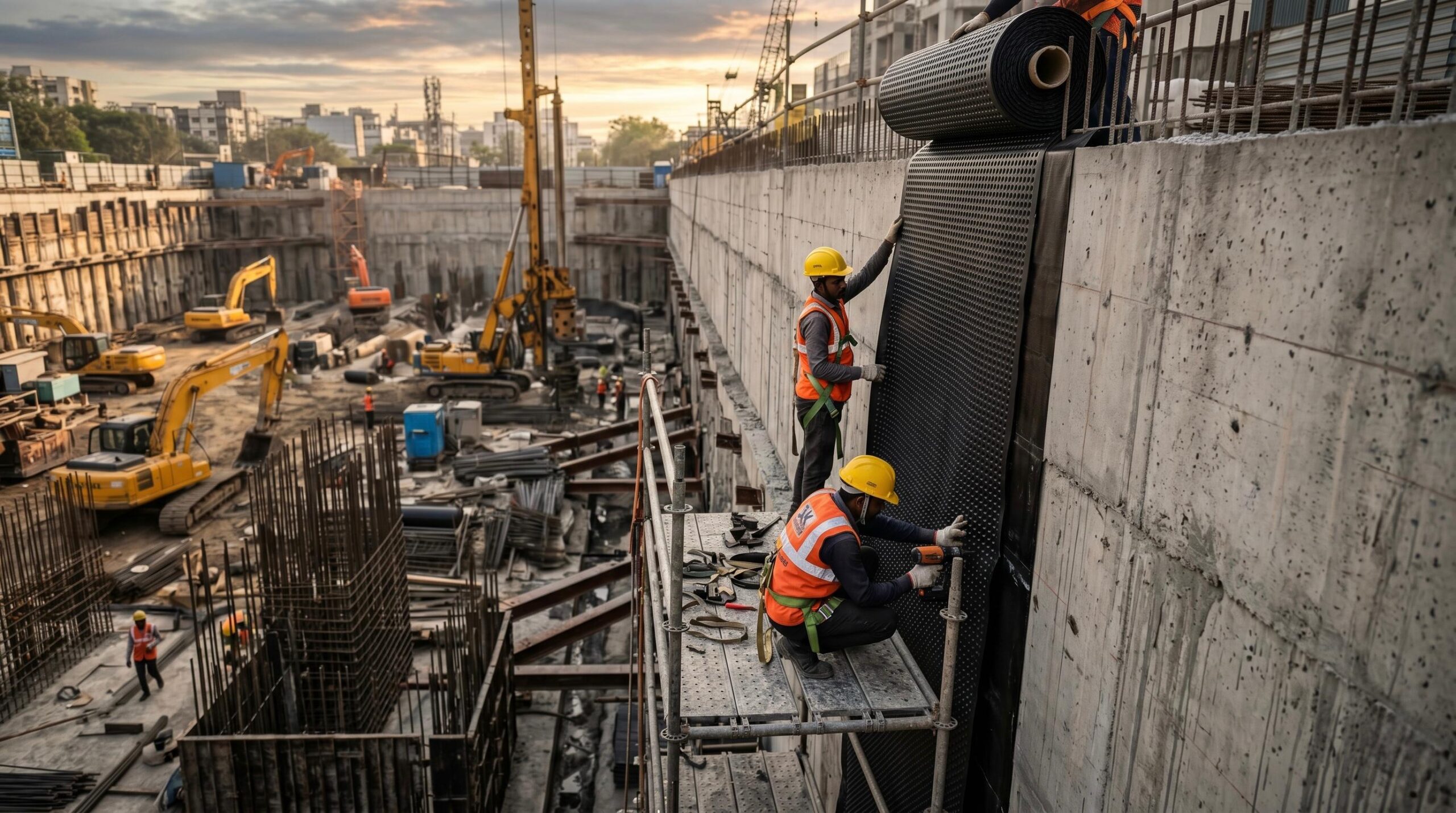
The primary application. The dimple board is installed vertically against the exterior face of basement walls — over the applied waterproofing membrane — before the excavation is backfilled.
The board performs two functions simultaneously: it shields the waterproofing membrane from backfill damage, and it channels any groundwater that reaches the wall down to the perimeter drain or footing drain system, preventing hydrostatic pressure buildup against the basement wall.
It is suitable for residential basements, commercial basement car parks, plant rooms, and any below-grade structure in contact with saturated or seasonally wet soil.
Explore: Basement & Tunnel Waterproofing →
Green Roofs and Planter Boxes
When installed horizontally beneath growing medium in green roof systems and large planter boxes, dimple board performs a drainage and water storage function.
Installed with dimples facing upward, the cups formed by the dimples retain a defined volume of water — providing reservoir supply to plant root zones during dry periods without requiring additional irrigation. Excess rainfall drains past the board to the roof drainage outlets, preventing overloading of the structural roof deck.
This dual function — storing water for plants and draining surplus water from the deck — makes dimple board a standard component in engineered green roof build-ups in commercial and urban landscape projects.
Explore: Green Roof & Planter Box Applications →
Tunnel Construction
In deep tunnel construction, dimple board is used as a primary drainage and waterproofing protection layer against the excavated rock face or shotcrete surface. Continuous subterranean water seeping through the rock mass is intercepted by the board and routed safely to the tunnel invert drainage system — preventing water accumulation against the primary concrete tunnel lining.
Installation Overview
Vertical Installation (Basement Walls, Retaining Walls)
- Apply the primary waterproofing membrane to the structural wall face and allow it to cure per the membrane manufacturer’s instructions
- Unroll the dimple board with the dimples facing outward (away from the wall) — the flat face against the waterproofing membrane surface
- Fix the board to the wall using mechanical fasteners at the top edge — standard fixings for HDPE sheeting
- Overlap adjacent rolls by a minimum of one dimple row at vertical joints to maintain continuous drainage coverage
- Terminate the bottom edge above the perimeter drain or drainage aggregate layer at the footing level
- Backfill carefully — avoid direct impact from large rocks or heavy compaction plant in contact with the board face
Horizontal Installation (Green Roofs, Planter Boxes)
- Lay the dimple board flat on the waterproofed roof deck surface — dimples facing upward for water retention, or downward for pure drainage
- Overlap adjacent rolls by one dimple row at joints
- Connect board to roof drainage outlets
- Place filter geotextile over the board before placing growing medium (if the board variant does not already have bonded geotextile)
Roll Format and Supply
Standard roll dimensions: 20 to 30 metres in length, up to 2 metres in width.
Wide rolls minimize the number of vertical seams during basement wall installation — reducing potential weak points in the drainage coverage and accelerating installation speed. Rolls can be cut to required dimensions on site using standard cutting tools without special equipment.
Custom dimensions are available on request.
Why Shivoham Fabtech?
Shivoham Fabtech supplies HDPE Dimple Drainage Board across India and to international markets, in both standalone and geotextile-laminated configurations.
- Four dimple heights — 8mm, 10mm, 15mm, 20mm for light to heavy-duty applications
- Two variants — standalone impermeable board and nonwoven geotextile laminated geocomposite
- NABL tested — puncture resistance, compressive strength, and flow capacity independently verified
- Wide roll format — up to 2m wide, 20–30m long, minimal seams during installation
- Technical support — dimple height selection and configuration guidance for project site conditions
- Domestic and export supply — info@shivoham.tech (domestic) · export@shivoham.tech (international)
📞 +91 98251 29394 🔗 Request Datasheet or Quote →
Shivoham Fabtech Pvt. Ltd. — IMS Certified (ISO 9001:2015 · ISO 14001:2015 · ISO 45001:2018) Geosynthetic Manufacturer & Supplier, Surat, Gujarat, India