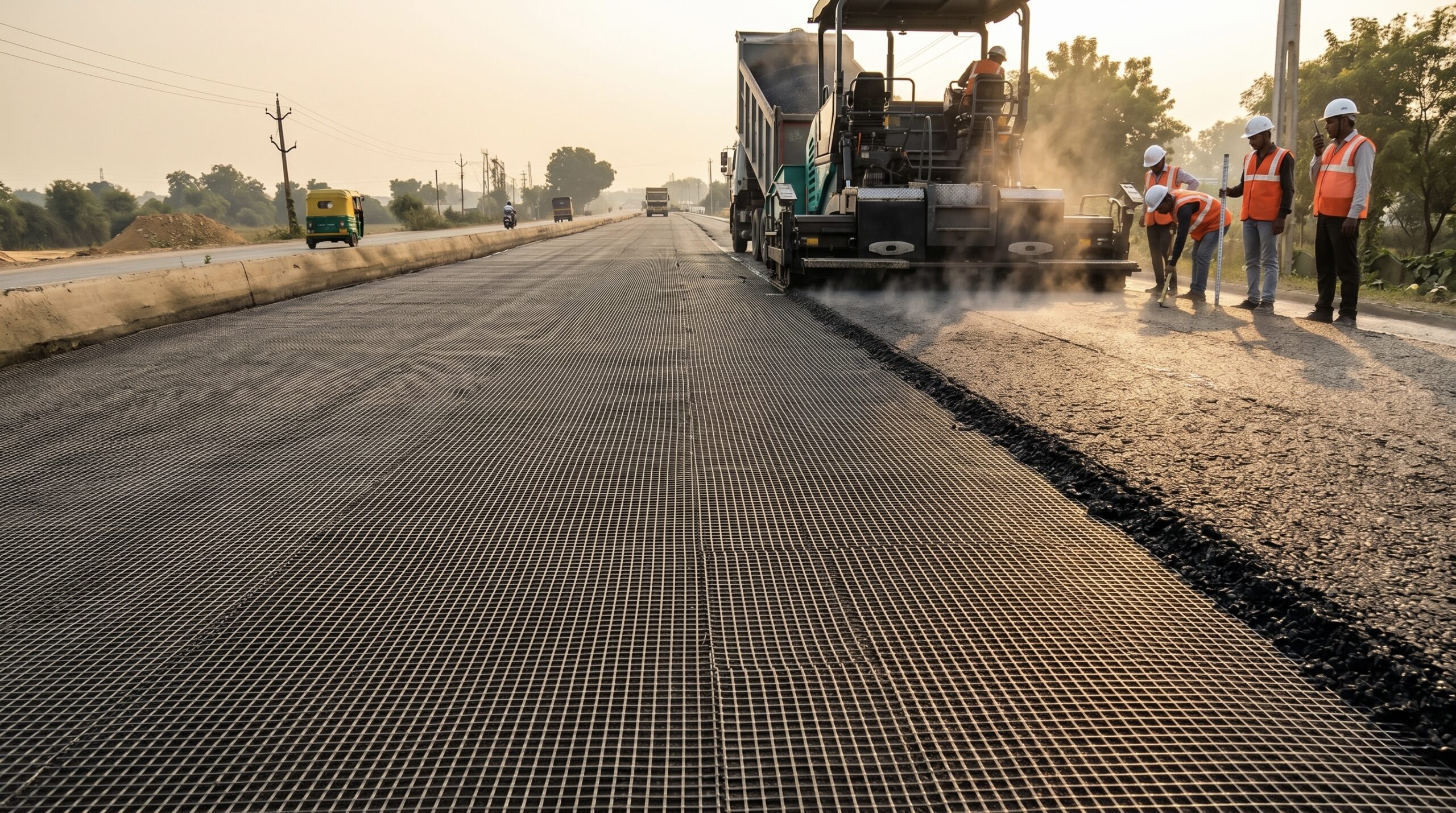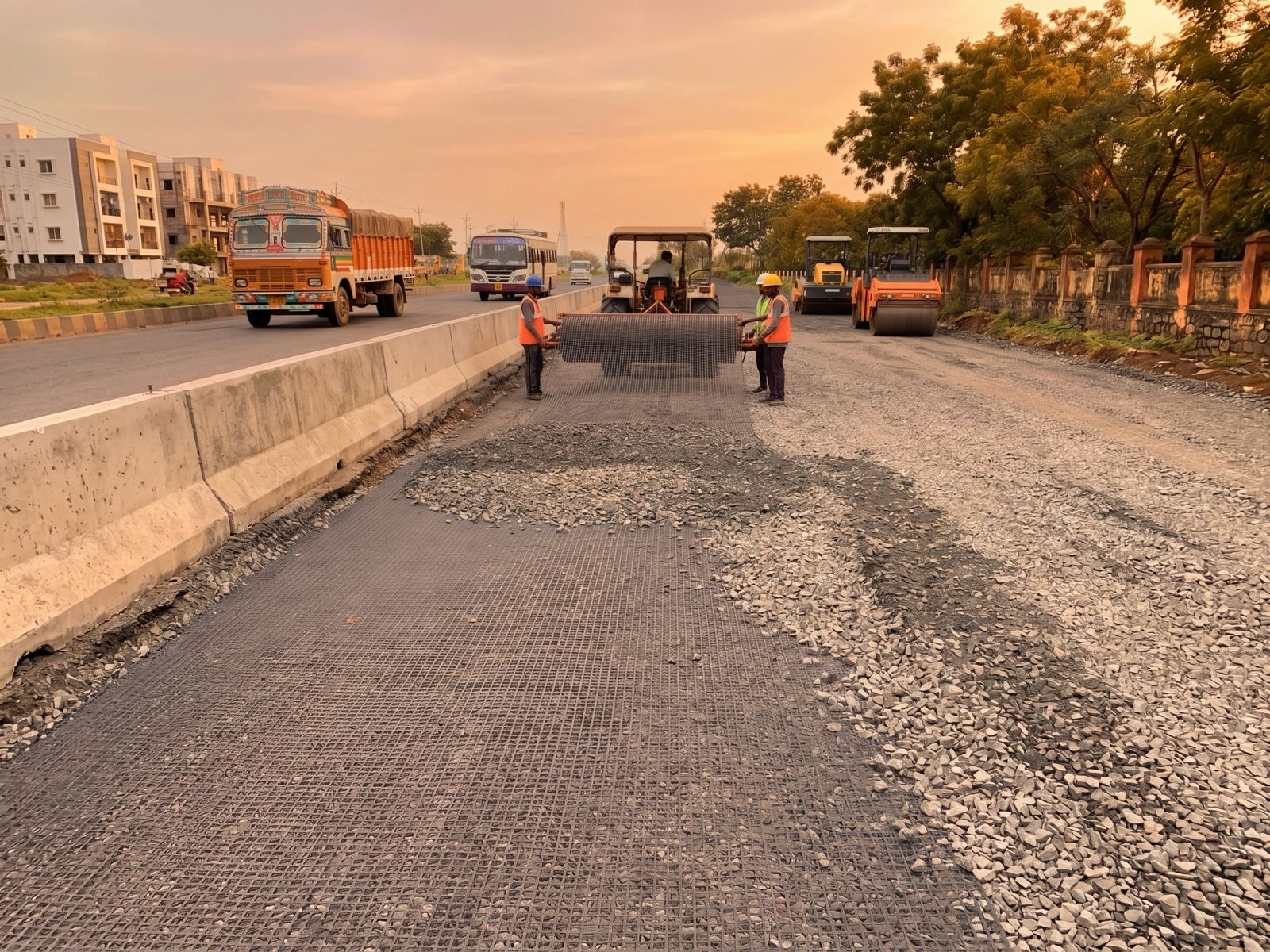
Reflective cracking is one of the most persistent and costly pavement failure modes in road maintenance across India. Cracks that exist in an underlying pavement layer — from fatigue loading, thermal cycling, or structural distress — propagate upward through new asphalt overlay layers over time, reappearing at the surface despite fresh resurfacing above them.
Glass fiber geogrid, placed as a reinforcement interlayer between the existing pavement and the new overlay, intercepts this crack propagation and significantly extends overlay service life. This guide explains what glass fiber geogrid is, how the crack arrest mechanism works, where it is applied, and how it is installed.
What is Glass Fiber Geogrid?
Glass fiber geogrid is a structural pavement interlayer manufactured from high-strength alkali-free glass fiber yarns, woven into an open mesh grid using European weaving technology and coated with a thermally stable elastomeric polymer.
The elastomeric polymer coating serves two engineering purposes: it bonds the woven glass fiber yarns together to maintain the grid’s aperture geometry during handling and installation, and it provides chemical and mechanical compatibility with the hot-mix asphalt layers that surround it during paving.
Key material characteristics:
- Fiber type: Alkali-free glass fiber (high-strength, dimensionally stable)
- Coating: Thermally stable elastomeric polymer
- Polymer coating melting point: ≥ 230°C — stable throughout hot-mix asphalt paving operations
- Glass fiber melting point: ≥ 820°C — the fiber remains fully intact under all normal paving and service temperatures
- Alkali resistance: The protective coating shields the glass fiber from alkali attack — qualifying the geogrid for direct placement on cement concrete surfaces as well as asphalt
Shivoham Fabtech’s Glass Fiber Geogrid is manufactured at its facility in Surat, Gujarat, and supplied in the SFGG product range.
Available Grades and Configurations
Standard Grid vs Geocomposite (CG) Variant
Standard Glass Fiber Geogrid: The open grid alone — placed as an interlayer between existing pavement and new overlay for crack arrest.
Composite Geogrid (CG Variant): A polypropylene nonwoven geotextile is bonded to the glass fiber grid. This combined product provides crack arrest from the geogrid together with a stress-relieving interlayer function from the geotextile — both in a single installation layer. The CG variant reduces the number of layers required in complex pavement rehabilitation where both crack control and stress relief are specified.
Roll Format
Standard roll widths: 1.0 m, 1.5 m, 2.0 m, and 3.0 m. Roll lengths vary by grade. Custom dimensions available on request.
How Glass Fiber Geogrid Controls Reflective Cracking
Reflective cracking develops because existing cracks act as stress concentration points at the base of a new overlay. Under repeated traffic loading and daily temperature changes, tensile stresses concentrate and intensify at each crack tip — eventually propagating upward through the new asphalt above.
The glass fiber geogrid interlayer interrupts this process through two mechanisms:
1. Stress absorption: The high elastic modulus of the glass fiber allows it to absorb tensile stresses at the level of the existing crack — at the low strain levels that occur under traffic loading — before those stresses accumulate to a level that can propagate into the asphalt above.
2. Crack bridging: The continuous grid structure bridges across existing crack openings in the pavement below. When the crack attempts to widen under thermal movement or load, the geogrid holds the two sides of the crack together, limiting stress concentration at the crack tip.
The combined result is that the upward propagation of the crack into the new overlay is significantly delayed — extending the time between resurfacing cycles and lowering the lifecycle maintenance cost of the road.
Applications
Road and Highway Pavement Overlay Reinforcement
The primary application. The geogrid is placed on the existing road surface before a new asphalt overlay is paved. It is used across national highways, state highways, and urban roads where the existing pavement is cracked but the underlying structure remains serviceable — rehabilitation without full reconstruction.
Explore: Road & Highway Applications →
Concrete-to-Asphalt Pavement Conversion
When cement concrete roads are converted to composite (concrete + asphalt) pavements, reflective cracking initiates at each concrete slab joint. The glass fiber geogrid’s alkali-resistant polymer coating makes it suitable for direct placement on the concrete surface, controlling reflective crack formation above the joint locations.
Airport Runway and Taxiway Rehabilitation
Airport pavements carry concentrated aircraft wheel loads that far exceed road traffic. Glass fiber geogrid’s high-grade options (100 kN/m and 200 kN/m) are specified for airfield pavement rehabilitation where both crack control and rapid return-to-service are required.
Explore: Airport Applications →
Road and Highway New Construction
In new pavement construction, glass fiber geogrid is placed within the pavement structure — between the binder and surface course — to reinforce the asphalt layers and distribute traffic-induced stresses, extending the overall pavement design life.
Bridge Deck and Approach Slab Overlays
Bridge decks are subject to thermal cycling between the concrete structure and the asphalt wearing course. This differential movement drives cracking at the interface. Glass fiber geogrid placed as an interlayer between the waterproofing layer and the wearing course controls this thermally-induced cracking. At approach slab transitions — where rigid concrete meets flexible asphalt — the geogrid distributes differential deflection stress across the joint.
Installation Overview
Option 1 — Tack Coat Method (standard):
- Clean and prepare existing surface — repair all potholes and deep structural failures before overlay
- Apply bitumen emulsion tack coat to existing surface
- Unroll glass fiber geogrid and press flat against the tack-coated surface
- Overlap adjacent rolls by a minimum of 150 mm at joints
- Apply second tack coat over the geogrid surface (if required by the project specification)
- Pave hot-mix asphalt overlay directly on top at normal machine speed and temperature
- Compact overlay with standard vibratory rollers
Option 2 — Pressure-Sensitive Adhesive (PSA) Backing: A PSA-backed version of the geogrid is available. The adhesive is activated by manual pressure during unrolling — eliminating the need for a separate tack coat operation where rapid installation is required or site conditions limit the use of liquid tack coat.
The geogrid becomes fully encapsulated within the asphalt system after overlay paving. No additional fixings or anchors are needed.
Quality Certifications
- ASTM Certified — tested per ASTM standards for geosynthetic tensile and physical properties
- NABL Accredited Laboratory Tested — independent testing at NABL-accredited facilities in India
- GAI-LAP Accredited Laboratory Tested — international geosynthetics testing accreditation
- IMS Certified manufacturer (ISO 9001:2015 · ISO 14001:2015 · ISO 45001:2018)
Why Shivoham Fabtech Glass Fiber Geogrid?
Shivoham Fabtech manufactures Glass Fiber Geogrid at its IMS Certified facility in Surat, Gujarat, supplying road, airport, and bridge pavement rehabilitation projects across India and internationally.
- Three grades — 50, 100, and 200 kN/m for road, highway, and airport applications
- Two variants — standard grid and Composite Geogrid (CG) with integrated nonwoven geotextile
- PSA backing available — for rapid installation on suitable sites
- Alkali resistant — qualified for direct placement on cement concrete road surfaces
- ASTM tested, NABL + GAI-LAP accredited — full test documentation with every order
- Technical support — grade selection, overlap design, and installation specification guidance
- Domestic and export supply — info@shivoham.tech (domestic) · export@shivoham.tech (international)
📞 +91 98251 29394 🔗 Request Datasheet or Quote →
Shivoham Fabtech Pvt. Ltd. — IMS Certified (ISO 9001:2015 · ISO 14001:2015 · ISO 45001:2018) Geosynthetic Manufacturer & Supplier, Surat, Gujarat, India