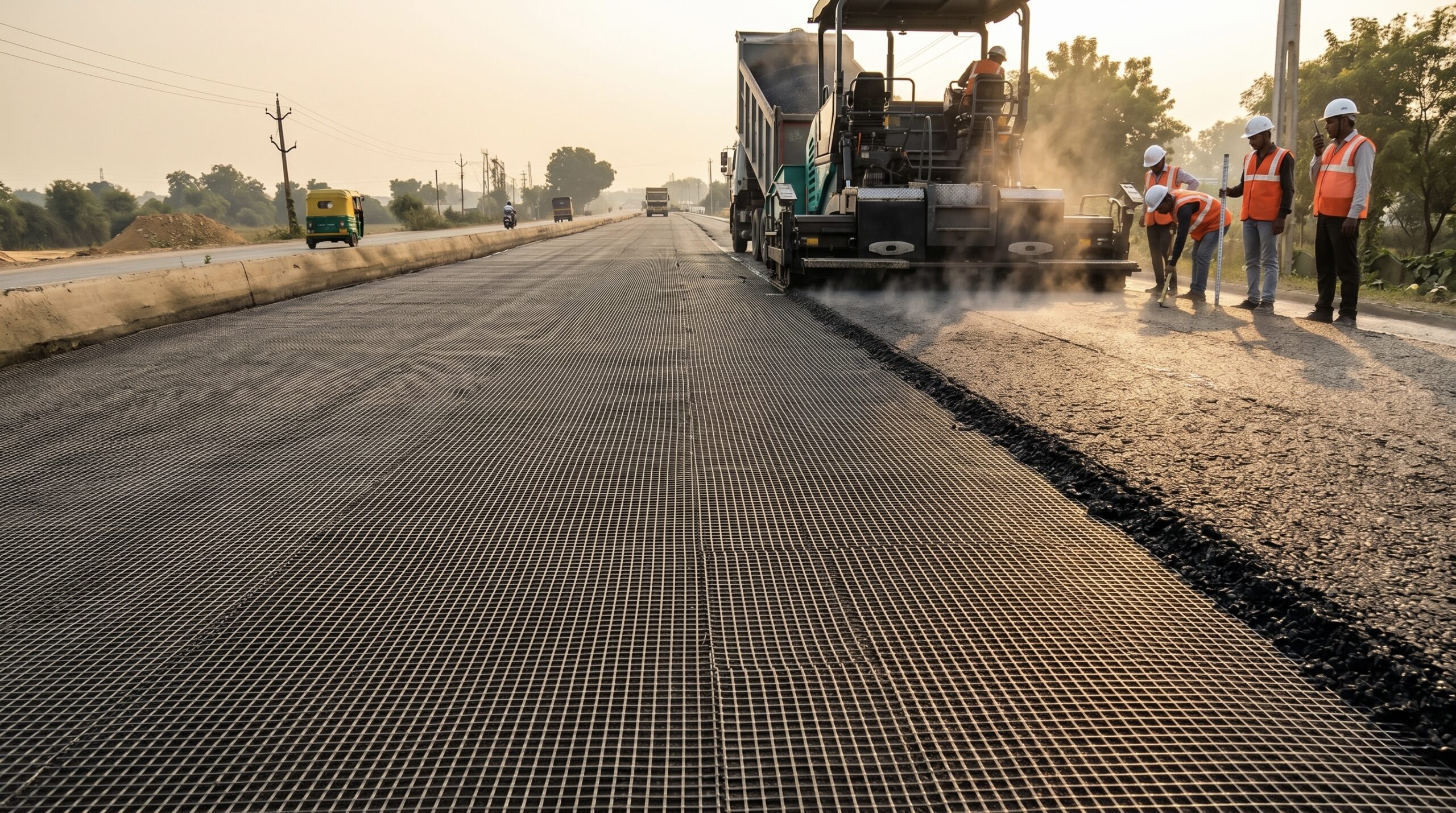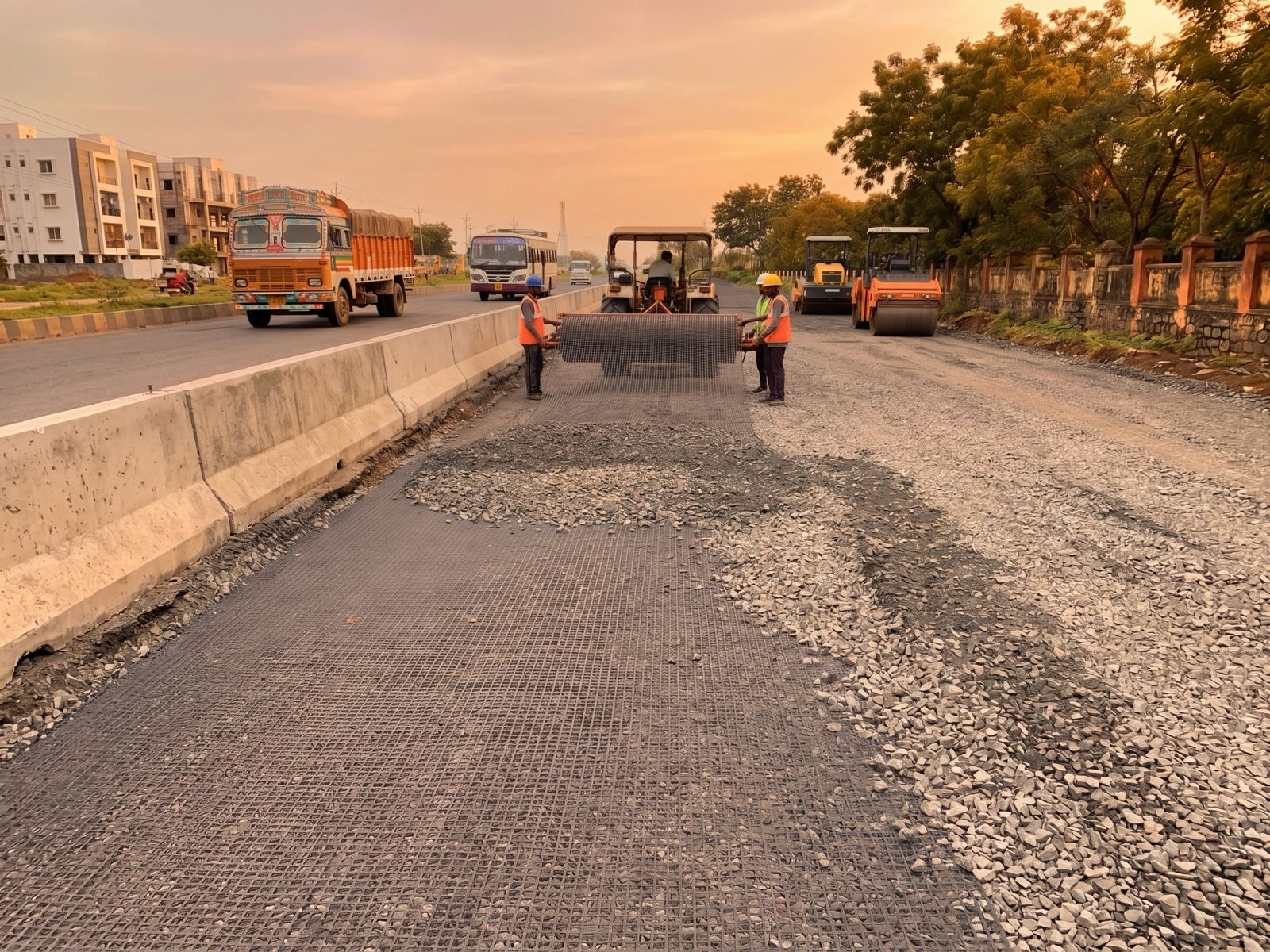
Biaxial geogrid is one of the most widely specified geosynthetic products in road construction across India. It is used to stabilize weak subgrade, reduce required aggregate thickness, prevent rutting, and extend the service life of both paved and unpaved roads. Yet the selection of the right biaxial geogrid — the correct material, aperture size, tensile strength, and junction type — is not always straightforward.
This guide explains what biaxial geogrid is, how it works in road applications, how it differs from polyester geogrid, and how to select the correct product for your project.
What is Biaxial Geogrid?
Biaxial geogrid is a geosynthetic grid with ribs running in two perpendicular directions — machine direction (MD) and cross-machine direction (CMD) — providing comparable tensile resistance in both orientations. This equal or near-equal strength in both directions makes biaxial geogrid ideal for applications where load is applied from multiple directions simultaneously, as in a road pavement system carrying vehicle traffic.
The most common raw material for biaxial geogrids is polypropylene (PP), processed through a punched sheet and drawn manufacturing method. The punching and biaxial drawing process orients the polymer chains in both directions, producing an integral grid with high junction efficiency.
Key structural characteristics of PP Biaxial Geogrid:
- Aperture shape: Typically square — providing equal resistance in both directions
- Junction type: Integral — the ribs and junctions are part of the same extruded sheet, not bonded or welded separately
- Tensile strength (MD and CMD): Typically 20 kN/m to 60 kN/m for standard road reinforcement grades
How Does Biaxial Geogrid Stabilize Road Subgrade?
The engineering benefit of biaxial geogrid in road construction comes from two mechanisms acting together:
Lateral Confinement of Aggregate
When a load is applied to the road surface — from vehicle wheels, construction plant, or compaction equipment — the aggregate in the base layer tries to spread laterally. Without reinforcement, this lateral spreading produces rutting at the surface and progressive degradation of the subgrade.
Biaxial geogrid placed at the base of the aggregate layer prevents this lateral movement. The aggregate interlocks with the grid apertures, creating a mechanically stabilised layer that resists lateral displacement under load.
Load Distribution
The reinforced aggregate layer acts as a stiffer composite mattress, distributing the applied wheel load over a larger area of subgrade. This reduces the peak contact stress on the subgrade surface, preventing bearing failure in weak or soft subgrade soils.
The combined effect of these two mechanisms typically reduces the required aggregate layer thickness for a given performance standard, or extends the service life of the road for a given aggregate thickness. The actual reduction in aggregate thickness depends on the subgrade bearing capacity (CBR), traffic loading, and design life — it is a project-specific design parameter, not a fixed percentage.
PP Biaxial Geogrid vs PET Polyester Geogrid — Key Differences
Engineers frequently ask when to use PP Biaxial Geogrid versus PET Polyester Geogrid. The answer depends on the application.
| Property | PP Biaxial Geogrid | PET Polyester Geogrid |
|---|---|---|
| Primary application | Road base stabilization, subgrade reinforcement | MSE walls, retaining structures, steep slopes |
| Strength orientation | Equal in both directions | Uniaxial or biaxial, typically higher UTS |
| Typical UTS | 20–60 kN/m (standard grades) | 30–400 kN/m (wide range) |
| Creep resistance | Moderate — adequate for road base applications | High — preferred for permanent retaining structures |
| Load direction | Multi-directional (vehicle traffic) | Predominantly uniaxial (wall facing tension) |
| Cost | Lower | Higher |
Use PP Biaxial Geogrid for: Road subbase stabilization, embankment base reinforcement, unpaved haul road construction, and working platform construction over weak subgrade.
Use PET Polyester Geogrid for: MSE retaining walls, steep slope reinforcement, bridge abutment fills, and any application requiring high sustained tensile load over a long design life.
Design Principles for Biaxial Geogrid in Roads
Biaxial geogrid road design in India follows the principles set out in MoRTH Specifications for Road and Bridge Works and IRC guidelines for flexible pavement design. The geogrid is treated as a reinforcement element that modifies the effective subgrade bearing capacity for pavement thickness design.
Key design inputs:
| Parameter | Significance |
|---|---|
| Subgrade CBR (%) | Primary indicator of subgrade strength — lower CBR requires stronger reinforcement |
| Traffic loading (MSA) | Million standard axles — determines pavement thickness and design life |
| Aggregate type | Particle size and angularity affects interlock with geogrid apertures |
| Geogrid aperture size | Must match aggregate particle size for effective interlock |
| Geogrid tensile strength | Selected to resist the expected lateral spreading force in the base layer |
For very weak subgrades (CBR below 3%), geogrid alone may not be sufficient — a combination of geotextile separator and geogrid reinforcement is typically specified, with the geotextile preventing fines contamination of the aggregate base.
Applications of Biaxial Geogrid in Road Projects
National Highway and State Highway Construction
MoRTH-funded highway projects specify biaxial geogrid in the sub-base or base course layer over weak or variable subgrade. The geogrid enables construction on ground conditions that would otherwise require deep excavation and soil replacement.
Rural and Agricultural Access Roads
Low-volume rural roads with unpaved surfaces and limited budgets benefit significantly from biaxial geogrid — the grid extends road life, reduces maintenance frequency, and allows the road to function during the monsoon season when subgrade strength is lowest.
Construction Haul Roads and Temporary Access
Construction haul roads for heavy vehicles (dump trucks, concrete mixers, cranes) on soft ground are routinely reinforced with biaxial geogrid to prevent premature rutting and maintain site access throughout the project programme.
Embankment Basal Reinforcement
Over soft compressible subgrades — silty soils, marine clays, reclaimed land — biaxial geogrid placed at the base of a road embankment prevents basal sliding failure and controls differential settlement during embankment construction.
Why Source Biaxial Geogrid from Shivoham Fabtech?
Shivoham Fabtech is an IMS Certified geosynthetics company (ISO 9001:2015 · ISO 14001:2015 · ISO 45001:2018) supplying PP Biaxial Geogrid to road infrastructure projects across India and international markets.
- Quality-assured supply — products sourced from verified manufacturing partners with documented product testing
- Full grade range — standard 20 kN/m, 30 kN/m, and 40 kN/m grades for road reinforcement applications; higher grades available on request
- Technical guidance — subgrade CBR — to — geogrid grade selection support for project engineers
- Reliable availability — consistent supply for both single-project quantities and long-term project schedules
- Compliant supply documentation — test certificates and compliance documentation provided with each supply
For specifications, samples, and project enquiries:
📞 +91 98251 29394 📧 info@shivoham.tech 🔗 Request a Quote →
Shivoham Fabtech Pvt. Ltd. — IMS Certified (ISO 9001:2015 · ISO 14001:2015 · ISO 45001:2018) Geosynthetic Manufacturer & Supplier, Surat, Gujarat, India