Geocell is one of the most versatile geosynthetic products used in civil engineering today. A single product — the HDPE Geocell — is deployed across road construction, slope protection, coastal erosion control, and load support applications. Yet despite its wide use, many engineers and procurement teams are still unclear about what geocell is, how it works, and when to specify it.
This guide covers geocell from first principles: its structure, its working mechanism, its key applications, and how it is installed in the field.
What is Geocell?
Geocell is a three-dimensional cellular confinement system manufactured from high-density polyethylene (HDPE) strips. The strips are ultrasonically welded at alternating intervals along their length. When the panel is expanded on-site, it opens into a stable honeycomb structure — a network of interconnected open cells.
Each individual cell is open at the top and bottom, allowing soil, aggregate, concrete, or vegetation to be placed inside. Once filled and compacted, the geocell and its infill act together as a reinforced composite layer with significantly higher load-bearing capacity and lateral stability than the infill material alone.
Geocell is typically supplied in collapsed panels for compact transport and site storage. On-site, each panel is expanded to its working dimensions and anchored in position before filling.
Key characteristics of HDPE Geocell:
- Cell depth: Typically 50 mm to 300 mm, selected based on application and load requirements
- Cell area: Varies by product specification — typically cell dimensions are project-specific
- Material: High-density polyethylene (HDPE) — UV stabilised and resistant to chemical attack, biological degradation, and hydrolysis
- Joint: Ultrasonically welded seams capable of withstanding tensile forces applied to the expanded panel
- Textured surface: Most geocell products have a textured internal surface to improve friction between the HDPE cell wall and the infill material
How Does Geocell Work?
The structural benefit of geocell comes from a mechanism called lateral confinement — the three-dimensional cell walls prevent the infill material from spreading sideways under vertical load.
Without confinement, granular fill or soil placed on a weak subgrade will deform laterally when loaded, causing settlement and surface rutting. With geocell, the cell walls absorb the lateral thrust, preventing outward movement of the infill. The result is a composite layer that behaves effectively as a stiff mattress distributing applied load over a larger subgrade area.
This confinement mechanism delivers three principal engineering benefits:
- Increased bearing capacity — the reinforced composite layer transfers load to a wider area of subgrade, reducing peak contact stress
- Reduced deformation — lateral restraint prevents rutting and differential settlement under repeated loading
- Shear resistance on slopes — cell walls act as small retaining elements, resisting the downslope shear forces that cause erosion and slope failure
Applications of Geocell
Road Subgrade Reinforcement
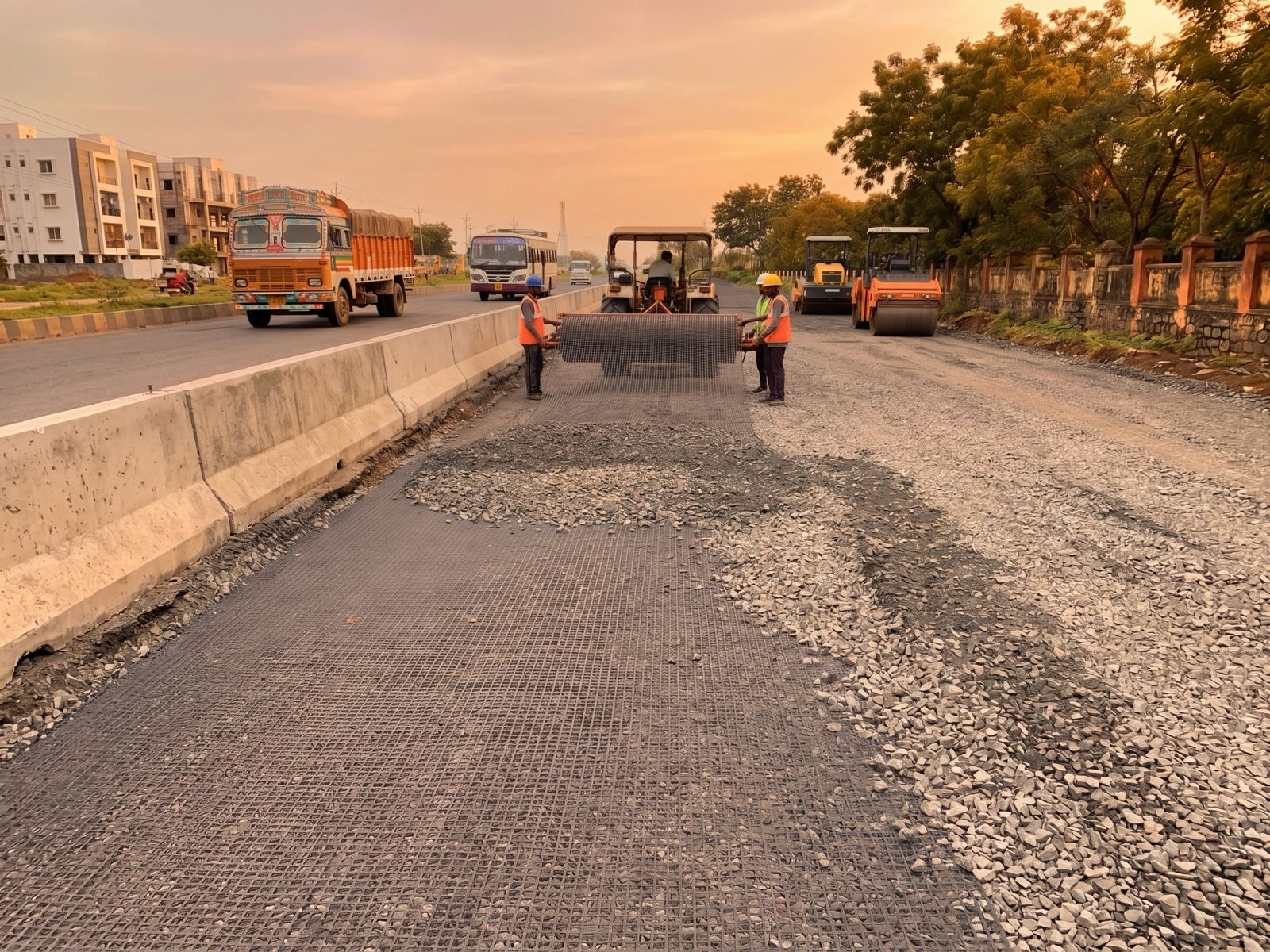
On roads with weak or variable subgrade soils, geocell is placed directly on the prepared subgrade surface before aggregate base layers are placed. The geocell layer stiffens the working platform, allows construction traffic to operate on otherwise inadequate subgrade, and reduces the total thickness of aggregate required to achieve the design bearing capacity.
This application is particularly effective on unpaved access roads, rural roads, and temporary construction haul roads where subgrade CBR values are low and aggregate is expensive or scarce.
Explore: Geosynthetics for Road & Highway →
Slope Stabilization & Erosion Control
Geocell is widely used for slope protection on highway embankments, railway cuttings, canal banks, and dam faces. Expanded panels are anchored to the slope face using U-pins or ground anchors and then filled with topsoil and seeded for a vegetated finish, or with concrete for a hard armour surface in high-energy hydraulic environments.
The geocell confinement prevents surface erosion by holding the infill in position even under rainfall impact and surface runoff. For vegetated slopes, the cells also retain moisture in the root zone, improving vegetation establishment on steep or dry slopes.
Explore: Geosynthetics for Slope Stabilization →
Coastal & Channel Erosion Protection
In hydraulic environments — tidal zones, river banks, drainage channels, and coastal revetments — geocell filled with concrete or crushed rock provides articulated armour protection. The cellular structure distributes hydraulic forces across the panel, preventing displacement of individual armour units under wave action or high-velocity flow.
Unlike rigid concrete paving, geocell revetment can accommodate minor foundation settlement without cracking, maintaining slope protection effectiveness over time.
Load Support Platforms & Haul Roads
Geocell mattresses placed over very soft soils — such as reclaimed land, peat, or saturated silty subgrades — provide a working platform capable of supporting construction plant before site improvement works are complete. The cellular mattress distributes the weight of excavators, dump trucks, and compaction equipment, preventing catastrophic bearing failure into soft ground.
This application is commonly used in port reclamation projects, marshland pipeline corridors, and temporary bridge approach fills.
How Geocell is Installed
Installation procedure varies by application. For a slope protection application, the typical sequence is:
- Prepare the slope surface — remove loose material, compact the slope, and install a geotextile filter layer to prevent fines migration from behind the geocell
- Place anchor trench at crest — excavate a trench at the top of the slope to anchor the first row of geocell panels
- Expand panels down the slope — open each collapsed panel and stake it in position with U-pins at the cell junctions
- Connect panels — adjacent panels are connected using bodkin rods or connector pins to form a continuous reinforced face
- Fill from top to bottom — fill each cell from the top of the slope downward, compacting the infill in layers of not more than 150 mm
- Seed or finish — for vegetated slopes, seed immediately after filling; for concrete armour, place concrete and allow to cure before opening to water flow
For road subgrade applications, the procedure is simpler: place geotextile separator, expand geocell panels flat on the subgrade, anchor perimeter, fill and compact with aggregate, then proceed with pavement layers above.
Geocell vs Conventional Slope Protection
Geocell vs Conventional Slope Protection
| Method | Performance | Flexibility | Cost | Vegetation |
|---|---|---|---|---|
| Geocell (concrete infill) | High | Articulated — handles settlement | Moderate | No |
| Geocell (vegetated infill) | Moderate | Articulated | Low | Yes |
| Cast concrete slab | High | Rigid — cracks under settlement | High | No |
| Gabion mattress | Moderate | Flexible | Moderate | Limited |
| Loose stone pitching | Low | None | Low | No |
Geocell with vegetated infill is the most cost-effective option for slopes in non-hydraulic environments. Geocell with concrete infill is suitable for hydraulic environments where wave action or surface flow velocities require a harder, non-erodible surface.
Why Choose Shivoham Fabtech for HDPE Geocell?
Shivoham Fabtech Pvt. Ltd. Supplies HDPE Geocell at its facility in Mangrol, Surat, Gujarat — engineered for slope protection, road reinforcement, coastal erosion control, and load support applications.
- IMS Certified (ISO 9001:2015 · ISO 14001:2015 · ISO 45001:2018) — Quality, Environmental, and Occupational Health & Safety Management
- Custom cell dimensions — cell depth and panel size available in project-specific configurations
- UV stabilised HDPE — resistance to ultraviolet degradation for exposed slope and revetment applications
- Technical support — specification assistance for slope angle, hydraulic loading, and fill selection
- Export supply — supply to projects across India, UAE, Saudi Arabia, and Southeast Asia
For technical datasheets, project-specific recommendations, and pricing enquiries:
📞 +91 98251 29394 📧 info@shivoham.tech 🔗 Request a Quote →
Shivoham Fabtech Pvt. Ltd. — IMS Certified (ISO 9001:2015 · ISO 14001:2015 · ISO 45001:2018) Geosynthetic Manufacturer & Supplier, Surat, Gujarat, India