Mechanically stabilized earth (MSE) walls are one of the most widely used retaining structures in modern civil infrastructure. From national highway embankments and railway cuttings to bridge abutments and industrial platforms, MSE walls deliver structural performance at significantly lower cost than traditional cast-in-place concrete alternatives, depending on site conditions and available fill.
This guide covers what MSE walls are, how they work, which geosynthetic reinforcement materials are used, and where they are applied in Indian infrastructure projects.
What is a Mechanically Stabilized Earth Wall?
A mechanically stabilized earth wall is a gravity retaining structure built from layers of compacted fill reinforced with horizontal geosynthetic or metallic elements. The reinforcement and surrounding soil act together as a composite mass, resisting the lateral earth pressure generated by the retained fill.
Unlike conventional concrete retaining walls that rely purely on the mass and rigidity of the structure, MSE walls work by mobilising the frictional interaction between soil and reinforcement to generate internal resistance. The result is a system that is structurally efficient, tolerant of imperfect foundation conditions, and economical to construct.
Key advantages of MSE walls over conventional retaining structures:
- Lower construction cost — typically 30–50% cheaper than cast-in-place concrete for equivalent wall heights, depending on site conditions and available fill materials
- Faster construction — no formwork, no curing time, no heavy crane dependence
- Tolerance to differential settlement — the flexible composite structure adapts to uneven foundation conditions without cracking
- Reduced foundation requirements — load is distributed over a larger base, reducing bearing pressure demand on the subgrade
- Suitable for large heights — MSE walls have been constructed to heights exceeding 20 metres in documented infrastructure projects
How Does a Mechanically Stabilized Earth Wall Work?
An MSE wall functions through the interaction of three distinct components:
1. Reinforced fill — granular backfill is placed and compacted in horizontal layers between sheets of reinforcement. The friction and interlock between soil particles and reinforcement elements prevents the fill mass from sliding outward.
2. Reinforcement elements — horizontal layers of high-tensile geosynthetics (PET Geogrid or Polyester Geostrip) or metallic strips are embedded in the fill at defined vertical spacing. These elements carry the tensile forces that would otherwise cause the wall to overturn or slide along its base.
3. Facing system — a vertical or near-vertical face consisting of precast concrete panels, segmental retaining wall blocks, wire mesh gabions, or wrapped and vegetated geotextile. The facing contains the fill at the exposed wall face but does not carry the primary structural loads of the system.
The reinforcement layers extend from the facing into the retained mass, anchored beyond a theoretical internal failure plane. As lateral earth pressure acts on the wall, the reinforcement tensile resistance prevents the failure plane from mobilising, maintaining overall wall stability.
Geosynthetic Reinforcement for MSE Walls
Two primary geosynthetic products are used in mechanically stabilized earth walls:
Polyester Geogrid
Two primary geosynthetic products are used in mechanically stabilized earth walls:
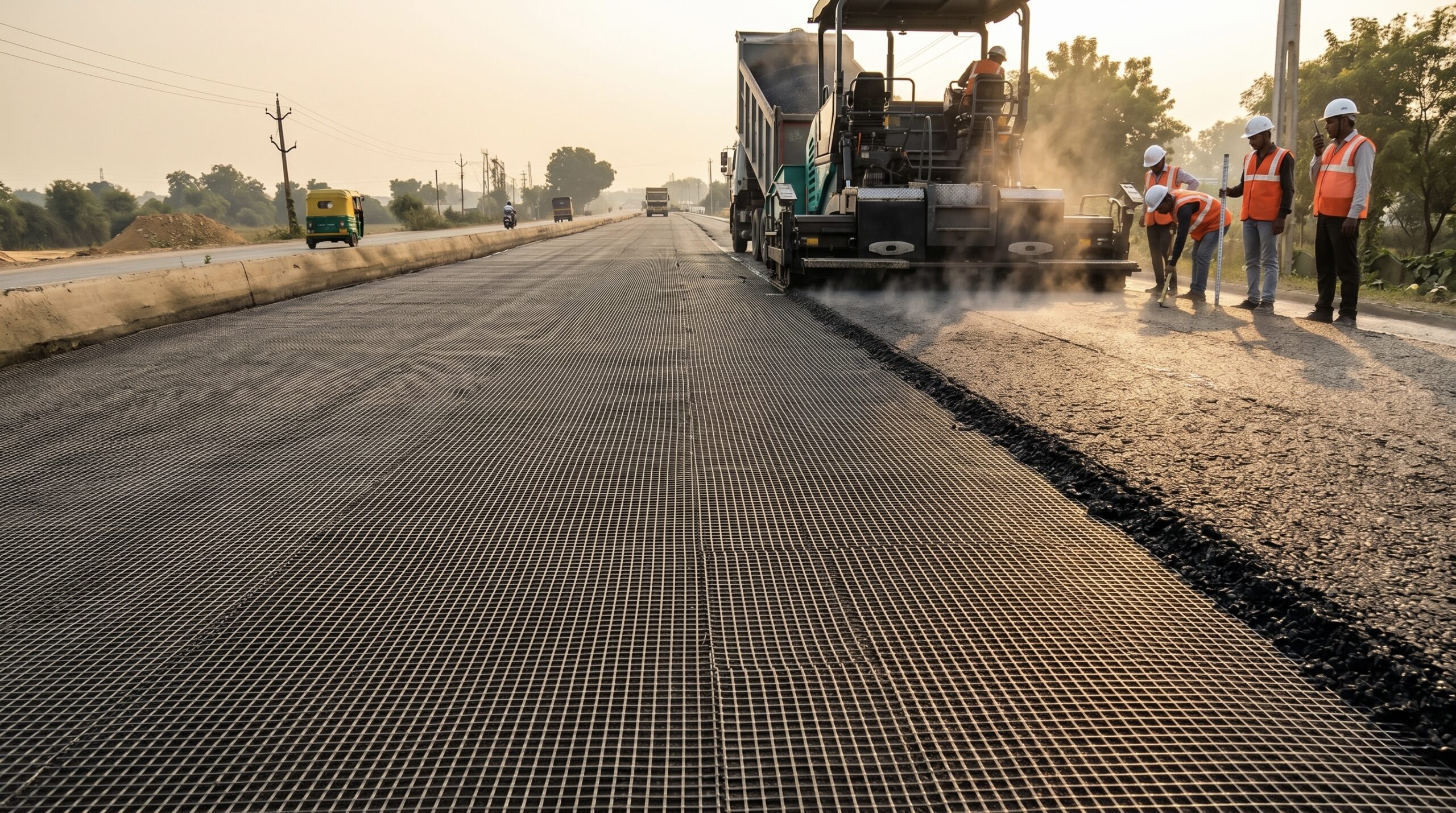
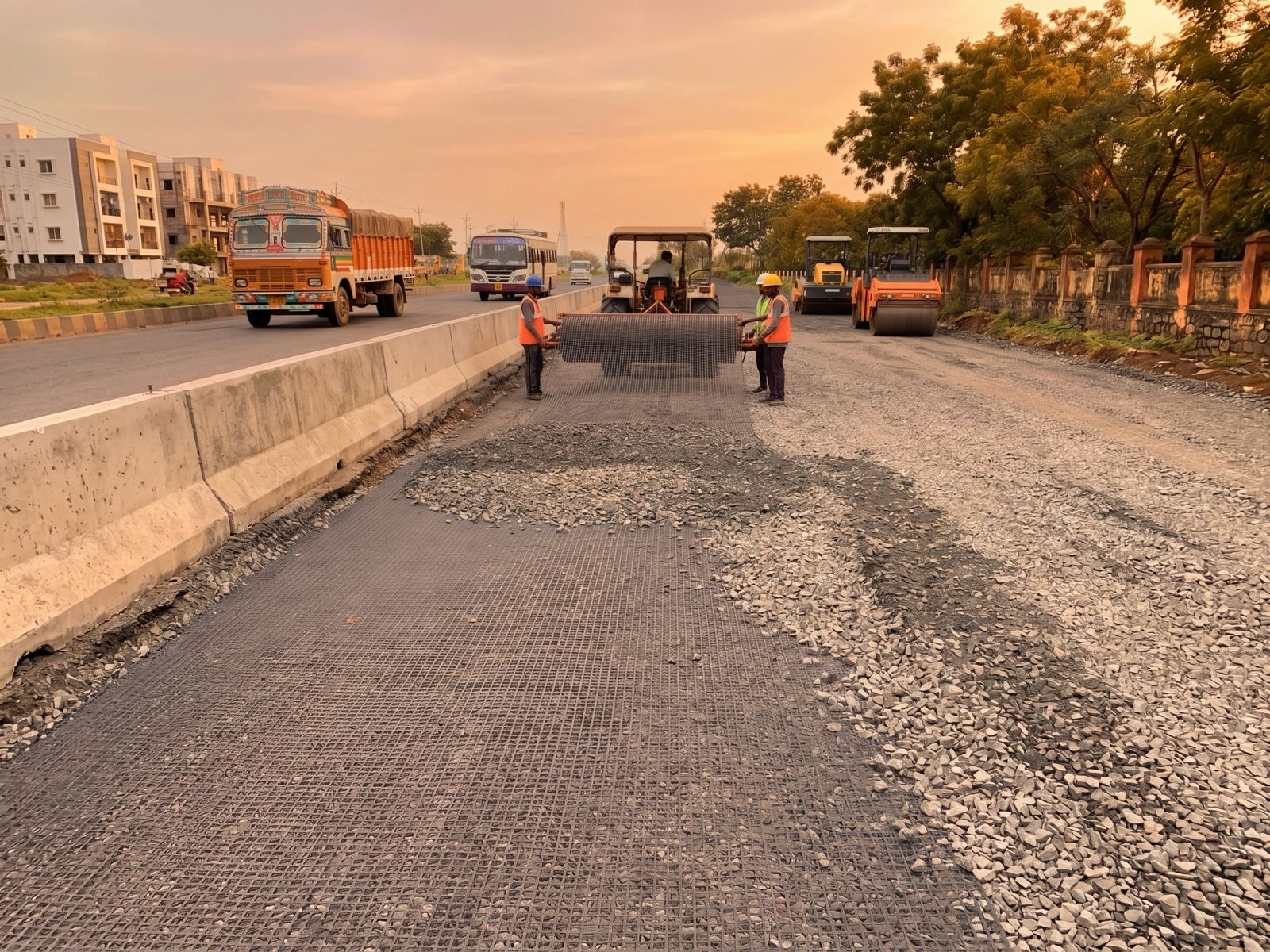
High-tenacity polyester geogrids are the most widely specified geosynthetic reinforcement for MSE walls in India. Their open grid structure allows soil particles to mechanically interlock with the geogrid apertures, developing both frictional resistance and passive bearing resistance against the transverse ribs.
Key properties required for MSE wall applications:
- Ultimate Tensile Strength (UTS): 30 kN/m to 200 kN/m, selected based on wall height, surcharge loading, and design life
- Low creep — polyester demonstrates significantly lower creep under sustained tensile load compared to polypropylene, making it the preferred reinforcement material for permanent retaining structures
- Durability — resistant to biological degradation, hydrolysis, and chemical attack in typical soil environments within the pH range 4 to 9
- Junction efficiency — the geogrid node or weld must maintain integrity under the full design tensile load throughout the structure’s design life
Polyester Geostrip
Geostrip, also referred to as a reinforcing strip or terre armée strip, is a flat, high-tenacity polyester strap used in reinforced soil retaining walls. Unlike geogrids, geostrips develop their pullout resistance entirely through direct friction between the strip surface and the surrounding granular fill.
Geostrips are commonly used with precast concrete facing panels in highway retaining wall systems where long-term performance under sustained tensile load is a primary design requirement.
Key properties:
- Width: Typically from 50 mm to 95 mm, depending on the design connection load
- UTS: Specified to match the peak design tensile load at the wall face connection point
- Connection: Bolted or loop-pinned through castings embedded in the precast concrete panel
- Surface: Ribbed surface profile to maximise soil-strip friction coefficient
MSE Wall Design Principles
MSE wall design in India is governed by IRC:SP:102 (Guidelines for Design and Construction of Reinforced Soil Retaining Walls) for highway projects, and MoRTH Specifications for Road and Bridge Works. For railway applications, RDSO issues applicable geotechnical specifications.
Key design parameters for a typical MSE wall:
| Parameter | Typical Range / Value |
|---|---|
| Wall height | 3 m to 20 m+ |
| Reinforcement vertical spacing | 300 mm to 600 mm |
| Minimum reinforcement length | 0.7 × wall height (L ≥ 0.7H) |
| Minimum fill friction angle | ≥ 30° (granular fill, per IRC:SP:102) |
| Design life | 75 to 120 years depending on structure classification |
| Long-term design strength | UTS ÷ (RF_id × RF_cr × RF_d × RF_chem) — see note below |
Note on long-term design strength: The characteristic tensile strength of the geosynthetic must be reduced by installation damage (RF_id), creep (RF_cr), durability (RF_d), and chemical resistance (RF_chem) reduction factors, as specified in the relevant national or international standard. The resulting design strength is typically 30–55% of the characteristic UTS, depending on geosynthetic type, installation environment, and design life. Always obtain product-specific reduction factors from manufacturer test data or the applicable standard.
The design tensile load within the reinforcement increases with depth below the wall crest and with the magnitude of live or dead surcharge at the top of the wall. Higher walls with heavy surcharge — such as adjacent highway or rail track loading — require higher UTS reinforcement at lower wall levels.
Applications of MSE Walls in India
Mechanically stabilized earth walls are specified across all major infrastructure sectors in India:
National Highway & Expressway Projects
NHAI highway and expressway projects routinely specify reinforced soil retaining walls in preference to conventional concrete structures, particularly where variable subgrade conditions, constrained right-of-way, or programme pressure favour flexible construction methods.
Railway Embankments & Bridge Abutments
Indian Railways and its project delivery arms use reinforced soil structures for embankment stabilisation at bridge approach zones and transitional fills, where differential settlement between the embankment and the bridge structure must be controlled. New Dedicated Freight Corridor (DFC) alignments in India have incorporated reinforced soil walls extensively.
Urban Flyovers and Interchange Ramps
Flyover approach embankments and grade-separated interchange ramps in constrained urban areas use MSE walls to achieve the required embankment geometry within available right-of-way, avoiding the significant land acquisition cost that wider conventional earth slopes would require.
Steep Reinforced Soil Slopes
Where terrain requires embankment slopes steeper than can be achieved with unreinforced fill, geogrid-reinforced soil slopes provide a stable structure that can be finished with a vegetated wrapped face, integrating with the surrounding landscape while maintaining full structural integrity.
Port and Heavy Industrial Platforms
Retaining structures at port container terminals and heavy industrial facilities are subject to substantial surcharge loading from gantry cranes, heavy goods vehicles, and material stockpiles. High-UTS PET Geogrids rated at 100–200 kN/m are specified for these applications to meet the structural demand.
Why Choose Shivoham Fabtech for MSE Wall Reinforcement?
Shivoham Fabtech Pvt. Ltd. manufactures PET Geogrids and Polyester Geostrips at its manufacturing facility in Mangrol, Surat, Gujarat, India — specifically engineered for mechanically stabilized earth wall applications.
- IMS Certified (ISO 9001:2015 · ISO 14001:2015 · ISO 45001:2018) — Quality, Environmental, and Occupational Health & Safety Management
- Full UTS range — PET Geogrid from 30 kN/m to 350 kN/m; Polyester Geostrip in 50 mm, 75 mm, and 100 mm widths
- Technical support — reinforcement selection assistance for project-specific wall heights, surcharge conditions, and fill parameters
- Export supply — documented supply to infrastructure projects in UAE, Saudi Arabia, Bangladesh, and Southeast Asia
For technical datasheets, project-specific specifications, and enquiries:
📞 +91 98251 29394 📧 info@shivoham.tech 🔗 Request a Quote →
Shivoham Fabtech Pvt. Ltd. — IMS Certified (ISO 9001:2015 · ISO 14001:2015 · ISO 45001:2018) Geosynthetic Manufacturer & Supplier, Surat, Gujarat, India